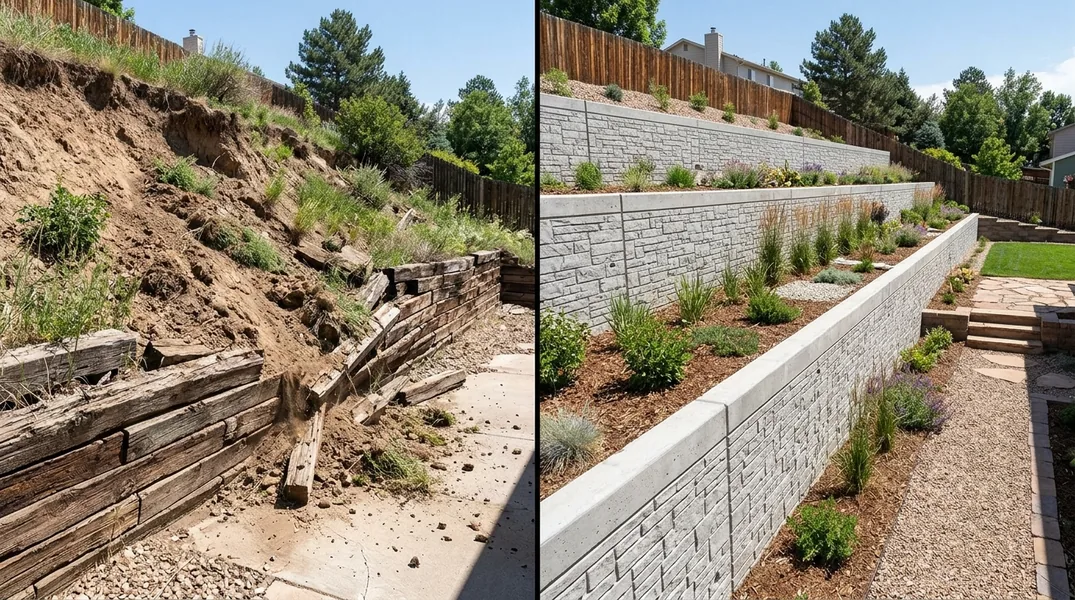
Understanding Denver Clay and Retaining Wall Failure
If you own property in Denver, you've likely heard about the region's notorious clay soil. This expansive clay is beautiful in many ways, but it poses serious challenges for retaining wall structures. Unlike sandy or loamy soils that drain predictably and remain stable, Denver's clay swells dramatically when wet and shrinks when dry. This constant expansion and contraction creates enormous lateral pressure against retaining walls, pushing them outward and causing structural failure over time.
The problem intensifies because Denver experiences freeze-thaw cycles during winter months. Water trapped in the clay freezes, expands, and applies additional force to your wall. Come spring, the soil thaws and settles unevenly. This repeated cycle weakens even well-constructed walls, which is why Retaining Wall Repair is one of the most common services contractors provide across the metro area. Many homeowners don't realize their wall is in danger until visible damage appears, making early detection critical.
Common Warning Signs of a Failing Retaining Wall
A leaning retaining wall is often the first visual clue that trouble is brewing. If you notice your wall tilting away from the soil it's meant to hold back, this indicates that soil pressure has overwhelmed the wall's resistance. This tilt typically starts small and gradually worsens, so catching it early gives you more repair options and lower costs. Many homeowners mistake a slight lean for normal settling, but in Denver's clay environment, any visible tilt warrants professional inspection.
Horizontal cracks running across the face of the wall are another red flag. These cracks form as the wall experiences bending stress from lateral soil pressure. Vertical cracks, especially those widening over time, suggest the wall is being pushed and pulled apart. If you see water seeping through the wall or pooling at its base, this indicates failed drainage and increased hydrostatic pressure, which accelerates failure. A bowing retaining wall, where the center of the wall bulges outward, means the soil pressure has become severe enough to deform the structure itself. Any of these signs warrant immediate attention from a qualified contractor.
Don't overlook subtle indicators like soil erosion at the wall's base, crumbling mortar between blocks, or vegetation growing at odd angles from the wall face. These suggest the wall is shifting and losing its structural integrity. If you're seeing any combination of these warning signs, contact Denver Retaining Wall at (983) 955-0165 to schedule a free estimate and get a professional assessment before the problem escalates.
Why Improper Drainage Accelerates Wall Failure
One of the most overlooked factors in retaining wall failure is inadequate drainage. When water builds up behind a retaining wall, it increases hydrostatic pressure exponentially. This pressure acts like an invisible force pushing the wall outward, and in Denver's clay soil, this combination is devastating. Many older retaining walls were built without proper drainage systems, or the drainage has become clogged over time with sediment and roots. Once drainage fails, water saturation turns the clay into a heavier, more expansive mass that puts tremendous stress on the structure.
Proper Retaining Wall Installation includes a perforated drain pipe behind the wall, gravel backfill, and sometimes a geotextile membrane to prevent soil migration. This system directs water away from the wall face and down to a proper outlet. Without it, water has nowhere to go except through the wall itself, causing erosion, freeze-thaw damage, and accelerated deterioration. If your wall was installed more than fifteen years ago, there's a good chance its drainage system has deteriorated or never existed. This is a primary reason why bowing retaining wall problems become common in Denver neighborhoods built in the 1980s and 1990s.
Bowing Retaining Wall Fix: When Professional Help is Essential
A bowing retaining wall fix isn't a DIY project. When the wall has deformed to the point of visible bowing, the structural integrity has been compromised significantly. At this stage, Retaining Wall Replacement is often the most cost-effective and safest solution, though professional engineers assess each case individually. Some walls can be saved through strategic Retaining Wall Repair techniques, such as installing tie-backs or buttresses to reinforce the structure, but this requires expert evaluation.
The repair approach depends on the wall's material, the extent of bowing, and soil conditions. Concrete Retaining Walls can sometimes be reinforced with additional support structures, while stone or block walls may need complete reconstruction. Denver Retaining Wall uses modern engineering principles and materials to ensure that replacement walls are built to withstand Denver's challenging soil and climate. Attempting temporary fixes without addressing the root cause typically results in failure within months, making professional intervention the smarter investment.
Retaining Wall Installation Cost in Denver: What to Budget
The cost of addressing a failing retaining wall varies widely depending on the wall's size, material, extent of damage, and repair versus replacement needs. A small repair might cost between $500 and $2,000, while a complete Retaining Wall Replacement can range from $3,000 to $15,000 or more for larger structures. Understanding the pricing factors helps homeowners make informed decisions. Replacement is often more expensive upfront but prevents ongoing problems and liability issues associated with a failing wall.
Investing in proper repair or replacement now is far less costly than ignoring the problem. A wall that continues to fail can damage your home's foundation, create safety hazards, and reduce property value. Denver's clay soil means that preventative maintenance and prompt repairs are essential. To understand what your specific situation will cost, contact Denver Retaining Wall at (983) 955-0165 or request a free estimate online. Our team will evaluate your wall, identify the underlying causes of failure, and recommend the most cost-effective solution for your property.
Taking Action: Inspection and Next Steps
If you've noticed any warning signs of wall failure on your Denver property, the time to act is now. Waiting allows damage to progress, costs to mount, and safety risks to increase. Professional inspection is the first step, and it's the best way to determine whether your wall needs repair, reinforcement, or replacement. An experienced contractor will assess soil conditions, drainage performance, structural integrity, and load-bearing capacity to recommend the right solution.
Denver Retaining Wall has served homeowners throughout the region for years, helping them understand their wall problems and providing lasting solutions tailored to Denver's unique soil challenges. Whether you need a minor repair or a complete rebuild, our team has the expertise to handle it. Don't let a failing wall compromise your property's safety or value. Call us today at (983) 955-0165 or visit our website to schedule your free estimate. We're ready to help you protect your investment and restore your peace of mind.
Looking for a professional retaining wall contractor in Denver? Denver Retaining Wall responds fast for all your retaining wall needs.
Get a Free QuoteOur services: Retaining Wall Installation · Retaining Wall Repair · Retaining Wall Replacement