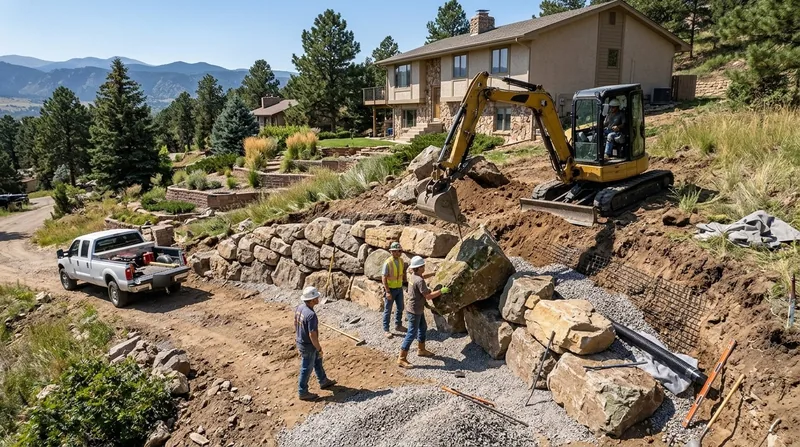




Boulder and natural stone walls in Denver blend seamlessly into the Front Range landscape, turning sloped yards and erosion-prone banks into durable, attractive features that last decades. Denver's high-altitude terrain, freeze-thaw cycles, and heavy spring snowmelt demand walls built below the frost zone with solid drainage and machine-placed rock that won't shift. From the pink and buff moss rock boulders common in Lakewood and the Highlands to stacked sandstone flagstone in Capitol Hill, natural stone walls anchor properties across the metro area. We install, repair, and replace boulder and natural stone walls using proven methods that account for Denver's swelling bentonite clay, intense sun, and seasonal water pressure. Whether your wall is leaning, cracked, or you're building one from scratch, we deliver Colorado-grade craftsmanship backed by local expertise. Call (983) 955-0165 for a free estimate, or learn more about our retaining wall installation services.
Why Boulder and Natural Stone Walls Matter in Denver's Sloped Yards
Denver's neighborhoods range from flat east-side lots to steeply sloped properties along Bear Creek, the Platte bluffs, and the foothill edge. Natural stone walls handle these slopes without the industrial look of concrete or segmental block, preserving the character of Victorian brick homes in Capitol Hill, 1950s brick ranches in Harvey Park, and 1970s tri-levels in Lakewood. Moss rock and sandstone walls fail when frost heave lifts the base, bentonite clay swells beneath them, or spring snowmelt and summer cloudbursts overwhelm drainage. A properly built natural stone retaining wall prevents erosion, stabilizes soil, and adds real property value in a market where landscape aesthetics matter.
- We machine-place each boulder and stone to lock into position, preventing the settling and tilting common in hand-stacked walls.
- We excavate below the frost line (typically 3 to 4 feet in Denver) so freeze-thaw cycles do not heave your wall upward.
- We install gravel and perforated drain behind the wall to shed water away from soil and prevent hydrostatic pressure buildup.
- We compact the base and backfill in lifts, creating a stable platform that resists bentonite clay expansion and heavy seasonal moisture.
- We select stone that matches your landscape and existing hardscape, whether moss rock, flagstone, or regional sandstone.
A well-engineered boulder wall stops erosion before it spreads to your driveway or foundation.
Key info: Many Denver neighborhoods require a permit for retaining walls above 4 feet or when a wall supports a surcharge like a driveway. Always check with your local building department. Engineered drawings may be required for tall or tiered walls. We handle permitting coordination and can refer you to approved engineers.
For more detail on regulations and permitting, refer to the Denver Community Planning and Development office.
How We Build Boulder and Natural Stone Walls in Denver
Our process starts with a site walk to assess slope, soil type, drainage, and proximity to structures or property lines. We then design a wall that sits below Denver's frost zone, anchors into stable soil, and sheds water away from your home or landscape. Machine placement and proper compaction are what separate a wall that lasts 30 years from one that fails in five. We also handle leaning and collapsed wall repair when an older moss rock or sandstone wall has shifted or cracked.
- We excavate the building area and remove old or failed wall material if replacing an existing structure.
- We dig below the frost line (Denver standard is 3 to 4 feet depending on elevation) and prepare a compacted gravel base.
- We set perforated drain pipe along the base and backfill with gravel to create a moisture-management layer behind the wall.
- We machine-place boulder or flagstone in lifts, setting each piece firmly and backfilling compacted soil behind it.
- We cap the top with larger stones or finished flagstone, grade the surrounding area, and ensure all water drains away from the wall.
From design to final grading, a typical natural stone wall installation takes 2 to 5 days depending on height, length, and site access.
Local example: A homeowner in Littleton had a 40-year-old moss rock wall leaning inward along her sloped backyard. We removed the failed wall, excavated 4 feet down into stable clay, installed new drain and gravel base, and rebuilt the wall with machine-placed pink and buff moss rock. The new wall is plumb, has no visible settling, and blends with her existing landscape.
See our full retaining wall drainage service for additional moisture-control options.
| Approach | Description | Best for |
|---|---|---|
| Machine-placed moss rock | Pink and buff boulders set with heavy equipment, compacted base and drain below frost line | Sloped yards in Lakewood, Harvey Park, Virginia Village where traditional look matters |
| Stacked flagstone | Sandstone or limestone blocks laid in courses with compacted gravel backing and perforated drain | Formal landscape in Capitol Hill or Washington Park, height up to 4-5 feet |
| Mixed boulder and flagstone | Large boulders as base, flagstone cap and face, professional finish with drainage | Hillside properties and premium landscapes where durability and aesthetics combine |
| Repair or cap of failed wall | Rebuild internal structure with new drain and base, face with matching stone, preserve existing material where possible | Leaning or cracked walls in Englewood, Wheat Ridge, Golden that need structural fix |
Boulder and Natural Stone Walls Cost in Denver: What to Expect
Boulder and natural stone wall installation typically starts at $25 per square foot for straightforward moss rock walls on accessible slopes. Costs rise with wall height, site access difficulty, the need for heavy equipment, complex drainage, and whether you are replacing a failed wall or building new. A 50-foot-long wall, 4 feet tall, can range from $5,000 to $8,000 or more depending on stone type, compaction depth, and local site conditions. Stacked flagstone and mixed materials run higher due to hand placement and finish work. We always provide a detailed, itemized estimate after a site visit so you know exactly what is included and what factors could affect the final cost.
- Stone type and availability (moss rock, sandstone, flagstone) affect material cost and delivery.
- Wall height, length, and slope determine excavation depth, base preparation, and labor hours.
- Site access, soil type, and proximity to structures or utilities may require special equipment or careful hand work.
- Permit requirements and engineered drawings (for walls over 4 feet or supporting a surcharge) add time and cost.
- Drainage complexity and water management systems increase the scope and price.
- Seasonal timing can affect labor availability and material delivery, especially in winter.
Always get 2 to 3 estimates from licensed contractors in your area so you can compare scope, materials, and timeline. See our full pricing guide for more detail on what drives cost in your specific job.
What to Look for When Hiring a Boulder and Natural Stone Wall Contractor Near Denver
A boulder or natural stone wall is a long-term investment in your property's stability and curb appeal. Choose a contractor who is licensed and insured, has built walls in Denver's specific soil and climate, and can explain how they will handle frost depth, drainage, and permitting. Ask for references from recent jobs in your neighborhood, Littleton, Lakewood, or Aurora so you can see how their work has held up over 2 to 3 years. Verify that the contractor understands Denver's permit thresholds and can coordinate with your local building department if needed. Get everything in writing, including materials, timeline, and total cost, before work begins.
- Confirm the contractor holds a valid Colorado contractor license and carries liability and workers compensation insurance.
- Ask for at least three references from natural stone or boulder wall jobs completed in the past two years in Denver or nearby areas.
- Verify the contractor understands frost depth (3 to 4 feet in Denver), bentonite clay behavior, and freeze-thaw damage prevention.
- Confirm that the contractor will obtain necessary permits or work with a licensed engineer for walls above 4 feet or supporting a surcharge.
- Request a detailed written estimate that includes stone type, base depth, drainage method, timeline, and final cost.
- Check that the contractor can explain how water will be managed during and after construction to prevent hydrostatic pressure and erosion.
Contact us today for a free, no-obligation estimate and a conversation about your wall's specific needs. Call (983) 955-0165 or visit our contact page to schedule a site visit in Denver, Aurora, Lakewood, or any of our service areas.
Boulder & Natural Stone Walls in Denver: Pricing Guide
| Service | Price | Details |
|---|---|---|
| Moss rock boulder wall, straightforward site | Starting at $25/sq ft | Machine-placed pink or buff moss rock, compacted gravel base below frost line, standard drainage, accessible slope |
| Stacked flagstone or mixed stone wall | Starting at $35/sq ft | Hand-placed sandstone or limestone, formal finish, professional cap, site access and compaction add labor complexity |
| Repair or rebuild of failed wall | Starting at $30/sq ft | Removal of old material, new structural base and drain, matching stone face, soil stabilization and compaction labor |
| Tall or tiered wall with engineered design | On estimate | Walls above 4 feet, supporting surcharge like driveway, or multiple tiers require site analysis, engineer drawings, permit coordination |
| Free estimate and site visit | No charge | Response within 24 hours, no obligation to book, detailed written quote with materials and timeline included |
Indicative pricing, the exact cost depends on square footage, finish, and site access. Free personalized estimate within 24h at (983) 955-0165.


