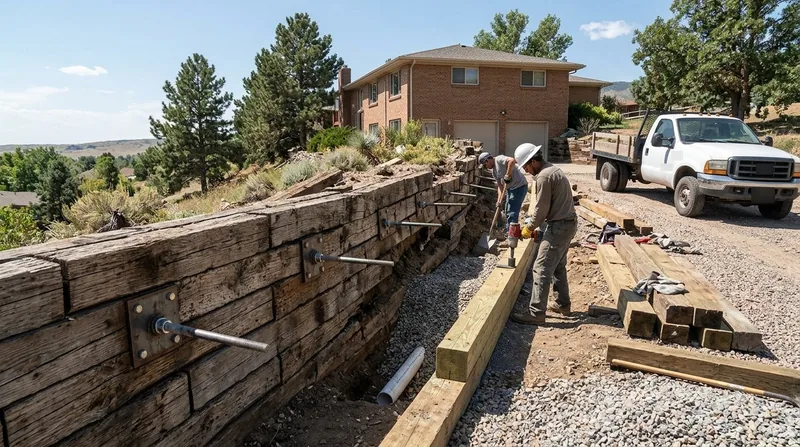




Denver's high-altitude terrain and clay-heavy soils create relentless pressure on retaining walls, especially during spring thaw and summer cloudbursts. A leaning and collapsed wall repair in Denver is often an emergency, not a convenience. The city's rolling lots in Lakewood, Littleton, and Bear Valley, combined with bentonite clay that swells when wet and frost heave cycles that crack foundations, mean your wall may fail suddenly after heavy snow melt or a July downpour. We respond fast to stabilize failing walls, correct drainage that's feeding the problem, and rebuild when necessary.
Why Leaning and Collapsed Walls Fail So Fast in Denver
Denver sits at the foot of the Front Range with soils that behave like a sponge when saturated. Bentonite clay expands dramatically when wet, pushing outward on wall faces with thousands of pounds of force. Freeze-thaw cycles in winter crack mortar and concrete. Spring snowmelt and summer thunderstorms deliver water faster than drainage can handle. Walls that lean or bulge are past the warning stage, they are failing now, and the longer you wait, the more expensive the fix becomes.
- Swelling clay pressure causes walls to lean outward and lose structural integrity over weeks or months.
- Frost heave lifts and destabilizes footings, especially in walls built in the 1970s and 1980s without modern drainage.
- Poor or blocked drainage allows water to accumulate behind the wall, multiplying pressure exponentially.
- Older landscape timber and railroad tie walls deteriorate from rot and UV exposure, losing strength just when clay pressure peaks.
- Undercut footings or shallow setbacks in older subdivisions fail when soil erodes or water undermines the base.
Once a wall leans visibly, stabilization or rebuild is the only safe option. Waiting for it to fail completely puts your property, driveway, or home at risk.
Key info: A 4-foot moss rock or sandstone wall in Harvey Park or Virginia Village can fail in a single wet spring. We've stabilized leaning walls in Denver and Aurora with tieback anchors in as little as one day, preventing full collapse and keeping repair costs from doubling.
For more detail on retaining wall failure modes and repair options, see our full retaining wall repair page.
The Colorado Division of Regulatory Agencies provides contractor licensing information at dora.colorado.gov, and the City and County of Denver requires permits for walls above roughly 4 feet measured from the footing. Always verify setback and height rules with your local building department before work begins.
How We Stabilize and Repair Leaning Walls in Denver
Our process starts with a same-day or next-day site visit to assess the wall's lean angle, soil moisture, drainage condition, and load. We then recommend tieback anchors, drainage correction, or partial or full rebuild based on what will hold safely and cost-effectively. Most leaning walls can be stabilized quickly, buying time for a planned rebuild, or saved entirely with the right drainage fix and anchoring strategy.
- We inspect the wall face, footing, and surrounding soil to identify the cause of lean or bulge.
- We measure water pressure and drainage performance behind the wall to confirm if wet clay is the primary driver.
- We install tieback anchors or helical anchors into stable soil to arrest outward movement and lock the wall in place.
- We excavate and repair or install new drainage systems, perforated pipe, and gravel to relieve hydrostatic pressure.
- We monitor the wall for 48 to 72 hours to confirm stabilization before final cleanup and restoration.
- If the wall is beyond saving, we remove it and rebuild with modern code-compliant materials and footings.
Most stabilization jobs in Denver take one to three days. Full rebuilds depend on wall length and material choice, but we prioritize fast turnaround so your property is safe and your yard is usable again.
Real example: A 30-foot timber retaining wall in Littleton was leaning 3 inches outward after heavy spring snowmelt. We installed four tieback anchors and rerouted surface water away from the wall base. The wall stabilized within 36 hours, and the homeowner avoided a $15,000 full rebuild. See our drainage correction service for more on how water management saves walls.
Repair Methods and When to Use Each
| Approach | Description | Best for |
|---|---|---|
| Tieback Anchor Installation | Steel rods or cables anchored deep into stable soil behind the wall, then connected to the wall face to pull it back into plumb. | Walls leaning less than 4 inches, or where the footing is still sound but clay pressure is active. |
| Helical Anchor Reinforcement | Screw-style anchors twisted into soil to lock footings in place and resist frost heave and subsidence. | Walls with undermined or settling footings, especially in Lakewood and Bear Valley where frost heave is severe. |
| Drainage Excavation and Repair | Dig behind the wall, remove saturated soil, install perforated drain pipe and gravel, and regrade to shed water away from the wall base. | Any wall with evidence of wet soil or seepage, especially those with no existing drain system or blocked gutters. |
| Partial or Full Wall Rebuild | Remove failed sections or the entire wall and rebuild with modern concrete, segmental block, or engineered timber, including proper footings and drainage. | Walls with severe lean (over 6 inches), extensive cracking, or material failure (rotted timber, crumbling concrete, spalling brick). |
Leaning and Collapsed Wall Repair Cost in Denver: What to Expect
Stabilization of a leaning wall with tieback anchors and drainage correction starts at $2,500 for a small wall or single-anchor job, and typically runs $4,000 to $8,000 for a 20 to 40-foot wall with multiple anchors and drainage work. Full wall rebuilds range from $6,000 to $20,000 or more depending on length, height, material choice, and site access. The single biggest cost driver is the wall length and whether you rebuild or stabilize and live with the repair.
Other factors that move the price up include difficult soil access (rocky ground or utility conflicts), proximity to structures or driveways that require protective shoring, engineered drawings if the wall is tall or sits on a steep slope, and local permit requirements. A wall in a Wheat Ridge walkout lot or a Bear Valley slope costs more to access and shore than a flat east-side lot in Denver. Always get two or three estimates so you understand the full scope and can compare approaches, not just price.
See our full pricing page for detailed cost breakdowns by wall type and repair method. Call us at (983) 955-0165 for a free, no-obligation estimate within 24 hours.
Leaning and Collapsed Wall Repair Near Me: What Denver Homeowners Should Know When Hiring
Choosing the right contractor for leaning wall repair is critical because the wrong approach can make the problem worse or leave you with a temporary fix that fails again in two years. Ask to see proof of a valid Colorado contractor license and current insurance before any work begins. Understand that walls above 4 feet or supporting a driveway typically require a city permit in Denver, and your contractor should handle the permit application and inspection coordination.
Get estimates in writing that spell out the method (tieback anchors, drainage, rebuild, or a combination), materials, timeline, and any permit or engineering fees. If you live in an HOA community, confirm that your HOA has no restrictions on wall repair methods or materials before signing a contract. Many HOAs in Capitol Hill, the Highlands, and Harvey Park have design guidelines that limit color or material choice, so know your rules upfront.
Don't choose based on lowest price alone. A contractor who rushes the job or skips drainage correction will leave you with a wall that fails again in a year or two. References from other Denver homeowners, a clear explanation of the repair method, and a realistic timeline are better guides than a cheap quote. Contact us for a free estimate and we'll walk you through the process step by step.
Leaning & Collapsed Wall Repair in Denver: Pricing Guide
| Service | Price | Details |
|---|---|---|
| Tieback Anchor Stabilization (1-2 anchors) | Starting at $2,500 | Stabilizes a small leaning wall or single-anchor repair, includes drilling, anchoring, and basic drainage surface grading |
| Multi-Anchor Stabilization with Drainage (3-4 anchors) | Starting at $5,500 | Stabilizes a 20 to 40-foot wall, includes tieback anchors, drainage excavation, perforated pipe installation, and gravel backfill |
| Helical Anchor Footing Repair | Starting at $4,000 | Addresses frost heave and settling footings, includes helical anchor installation and soil stabilization without full wall rebuild |
| Partial or Full Wall Rebuild | Starting at $8,000 | Rebuild 20 to 40 feet of wall with modern materials, proper footing depth, and integrated drainage, cost varies by length and material choice |
| Emergency Stabilization (same-day or next-day response) | Call for quote | Priority dispatch for collapsed or severely leaning walls, includes rapid assessment and temporary bracing if needed before permanent repair |
| Free Estimate | No charge | On-site inspection, photos, written assessment, and repair method recommendation within 24 hours, no obligation to book |
Indicative pricing, the exact cost depends on square footage, finish, and site access. Free personalized estimate within 24h at (983) 955-0165.


