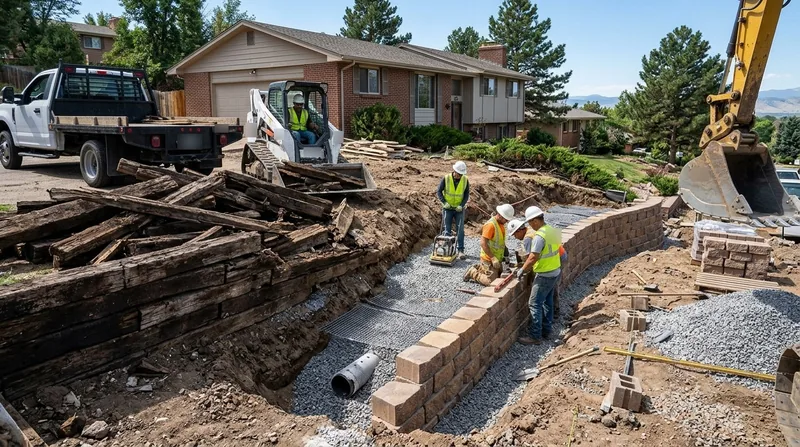




Railroad Tie Wall Replacement in Denver is one of the most common retaining wall projects we handle, because thousands of homes built in the 1970s and 1980s across Lakewood, Littleton, Harvey Park, and the foothills still have creosote-treated railroad ties holding back their sloped yards. These walls fail predictably in Denver's climate: freeze-thaw cycles crack the wood, bentonite clay swelling pushes from behind, and our intense high-altitude sun and heavy spring snowmelt accelerate rot. When a railroad tie wall starts to lean, bulge, or collapse, you need it replaced fast, before soil erosion undermines your foundation or driveway. We remove the old ties, haul them away, install proper drainage and gravel backfill, and rebuild in segmental block, poured concrete, or moss rock that will hold for decades. This page explains why railroad tie walls fail in Denver, how we replace them, what it costs, and what to expect when you call.
Why Railroad Tie Walls Fail in Denver: Freeze-Thaw, Clay, and Time
Denver sits at 5,280 feet on the high plains at the foot of the Front Range, where winters regularly dip below freezing and spring brings heavy, wet snow followed by intense runoff. Creosote railroad ties installed 40 to 50 years ago were never designed to last forever, and our climate is brutal on wood. Water seeps into the ties, freezes, expands, and cracks the wood from the inside out. Behind the wall, bentonite clay (common in Denver and the metro) swells when wet, pushing the wall forward with tremendous force. When drainage fails or isn't present at all, hydrostatic pressure builds up, the ties lose structural integrity, and the wall leans or collapses.
- Freeze-thaw cycles split creosote ties from the inside, weakening them year after year until they cannot support the weight of soil behind them.
- Bentonite clay expands when saturated by spring snowmelt and summer cloudbursts, pushing the wall forward and causing visible bulging or tilting.
- Poor or missing drainage allows water to pool behind the wall, increasing hydrostatic pressure and accelerating tie rot.
- Root growth and settling soil create gaps and voids that destabilize the tie structure and allow further water infiltration.
- Sun exposure and age cause the creosote coating to break down, exposing bare wood to rapid deterioration.
All of these failure modes are preventable with proper replacement and drainage design.
Key info: A leaning or bulging railroad tie wall in Denver is not a cosmetic issue. It signals imminent failure and soil movement that can damage your driveway, foundation, or landscaping. We recommend an inspection as soon as you notice tilting, separation between ties, or soil erosion at the base. Contact us at (983) 955-0165 for a free estimate and honest assessment.
For more detail on what causes wall failure, see our Leaning and Collapsed Wall Repair service page. The Denver Building Department publishes guidance on retaining wall permits and standards; you can review their codes and permitting thresholds here.
How We Replace Railroad Tie Walls in Denver: Step-by-Step Process
Our railroad tie wall replacement process starts with a site visit to assess the wall height, soil conditions, drainage, and what's behind it (driveway, patio, landscaping). We determine whether the job requires a permit (walls over roughly 4 feet from footing typically do in Denver jurisdictions), plan the demolition, and schedule the work. We remove the old ties, haul them away responsibly, install new drainage fabric and gravel, compact the base, and build a new wall in your choice of material. The entire job usually takes 3 to 7 days depending on wall length and material selection.
- We mark the work zone, protect adjacent landscaping and utilities, and set up equipment for safe tie removal.
- We excavate and remove all creosote-treated railroad ties and old backfill, hauling debris to an approved waste facility.
- We inspect the retained soil and bearing surface, removing any unstable material and compacting the base.
- We install perforated drainage pipe at the base and landscape fabric behind the wall to prevent soil migration and manage groundwater.
- We place and compact new gravel backfill to restore proper drainage and support behind the new wall.
- We build the new wall in segmental block, poured concrete, or stacked moss rock, depending on your preference and site conditions.
- We finish the top, compact the final backfill, and restore landscaping or hardscape as needed.
This systematic approach ensures the new wall is stable, durable, and properly drained so it lasts for 25 to 40 years without the problems that plagued the old tie wall.
Example: A homeowner in Littleton with a 30-foot-long, 4-foot-tall railroad tie wall backing a sloped driveway called us after the wall started to bulge. We removed the ties in one day, installed drainage and gravel, and rebuilt in segmental block over two days. Total time: three days. The new wall is stable, the driveway is secure, and drainage now handles spring runoff properly. No more leaning, no more worry.
Learn more about our general retaining wall replacement services and the drainage solutions we install to prevent future failures.
Railroad Tie Wall Replacement Materials: Segmental Block, Concrete, and Moss Rock
Once the old ties are gone, you have three main choices for the new wall. Each offers different durability, appearance, and cost. Segmental block (also called SRW or modular retaining wall block) is the most popular choice in newer Denver subdivisions because it's fast to install, requires no special equipment, and comes in many colors and sizes. Poured concrete is ideal for tall walls or walls with a finished face, and it's very durable in our freeze-thaw climate. Stacked moss rock or natural stone gives a more traditional, landscape appearance and blends well with the Victorian brick and historic neighborhoods of Capitol Hill and the Highlands.
| Material | Description | Best For |
|---|---|---|
| Segmental Block (SRW) | Interlocking modular blocks, typically 8 to 12 inches tall, stacked with a slight batter (lean-back). Fast to install, minimal equipment, stable and durable. | Most residential projects, walls up to 12 feet, modern subdivisions, driveways, and tiered landscapes. |
| Poured Concrete | Monolithic reinforced concrete wall, engineered and formed on-site. Excellent freeze-thaw resistance, very strong, minimal maintenance. | Tall walls, walls with heavy surcharge (driveway or structure), high-load applications, and areas where a clean finished face is desired. |
| Stacked Moss Rock | Pink and buff Colorado moss rock, hand-stacked dry or mortared. Traditional appearance, blends with natural landscape, heavy material. | Historic neighborhoods, landscape-forward designs, shorter walls, and sites where natural stone appearance is valued. |
| Landscape Timber | Pressure-treated or composite timbers, typically 6 by 8 or 6 by 10 inches, stacked horizontally. Warm appearance, easier to install than stone. | Lower walls, residential landscaping, areas where wood aesthetic fits, and shorter-term applications (10 to 15 years typical life). |
We help you choose the right material based on wall height, soil conditions, your landscape style, and budget. Segmental block and poured concrete are the most durable long-term choices in Denver's climate.
Railroad Tie Wall Replacement Cost in Denver: What to Expect
Railroad tie wall replacement in Denver typically starts at $35 per square foot for segmental block reconstruction on a straightforward job with good access and stable soil. A 30-foot-long, 4-foot-tall wall, for example, would be approximately 120 square feet, putting the base cost in the $4,200 to $5,000 range. However, several factors can move that price up or down. Difficult access (narrow gates, steep terrain, tight spaces), poor drainage conditions requiring extensive gravel and fabric work, soil that needs stabilization, or a choice of premium materials like poured concrete or stacked moss rock will increase the cost. Walls requiring engineered drawings (typically those over 8 feet or supporting a structure) add design and permitting costs. We always provide a detailed estimate after a site visit, so you know exactly what you're paying for.
We recommend getting 2 to 3 estimates from licensed contractors in Denver, Lakewood, Littleton, and surrounding areas. Compare not just price, but what's included: drainage design, backfill quality, material choice, and warranty. A cheap estimate that skips proper drainage will fail in a few years. A thorough estimate that addresses soil conditions and includes a warranty is worth more upfront.
For a complete pricing breakdown and to discuss your specific wall, visit our pricing page or call (983) 955-0165 for a free, no-obligation estimate. We respond within 24 hours.
Railroad Tie Wall Replacement Near Me: What Denver Homeowners Should Know Before Hiring
When you're ready to hire a contractor for railroad tie wall replacement in Denver, Lakewood, Littleton, or surrounding areas, a few key steps will protect your investment and ensure quality work. First, confirm that the contractor is licensed and insured for retaining wall work in Colorado. Ask to see a current certificate of insurance and a copy of their contractor license. Second, get everything in writing: the scope of work, materials, timeline, drainage plan, and warranty. Third, check references from past clients in your area and ask specifically about drainage performance and how the wall has held up over time. Fourth, understand whether your wall needs a permit. Most Denver jurisdictions require a permit for walls over roughly 4 feet measured from the footing, or when a wall supports a driveway or structure. Your contractor should handle permitting, but you should know the requirements. Finally, if your property is in an HOA, check with your homeowners association before starting work to confirm that your replacement design is approved.
We handle all permitting, provide detailed estimates in writing, offer references from local projects, and stand behind our work with a warranty. Contact us today to schedule your free estimate and get started on a railroad tie wall replacement that will last.
Railroad Tie Wall Replacement in Denver: Pricing Guide
| Service | Price | Details |
|---|---|---|
| Segmental Block Replacement | Starting at $35/sq ft | Includes demolition, drainage installation, gravel backfill, and new block wall construction. Price varies with wall height, access difficulty, and soil conditions requiring stabilization. |
| Poured Concrete Wall | Starting at $45/sq ft | Engineered reinforcement, formwork, concrete placement, and finishing. Ideal for tall walls or heavy surcharge. Premium freeze-thaw durability in Denver climate. |
| Stacked Moss Rock Wall | Starting at $50/sq ft | Hand-stacked Colorado moss rock, mortared or dry-laid. Higher labor and material cost. Best for shorter walls and landscape-forward designs in Capitol Hill and historic neighborhoods. |
| Complex or Tiered Project | On estimate | Walls requiring engineered drawings, multiple tiers, slope stabilization, or extensive drainage work. Site visit required to assess soil, access, and permit scope. |
| Travel and Estimate | Free | No mileage charge for Denver and surrounding areas. Free written estimate provided within 24 hours. No obligation to hire us after estimate is delivered. |
Indicative pricing, the exact cost depends on square footage, finish, and site access. Free personalized estimate within 24h at (983) 955-0165.


