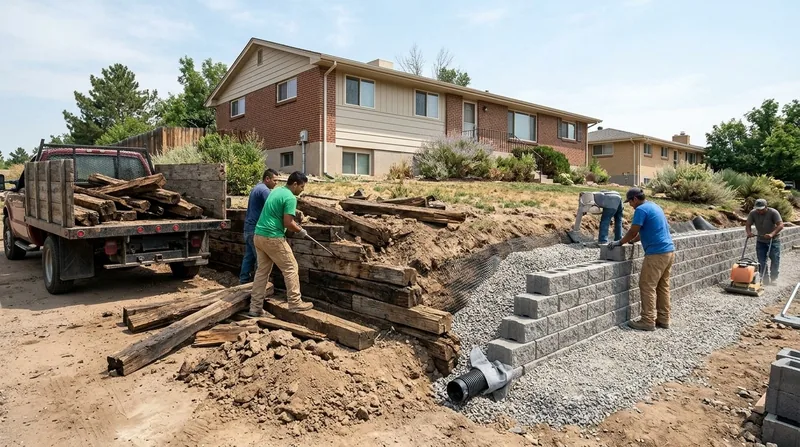




Retaining Wall Replacement in Denver is a critical service for homeowners dealing with failed or end-of-life walls across the metro area. Denver sits at the foot of the Front Range on high plains terrain, where swelling bentonite clay, freeze-thaw cycles, and heavy spring snow create relentless pressure on aging retaining structures. Landscape timber and railroad tie walls installed in the 1970s and 1980s are rotting and collapsing. Pink and buff moss rock boulder stacks are leaning. Segmental block walls in newer subdivisions are cracking. When a wall fails, water infiltration accelerates the damage, and the risk to property and safety grows fast. Denver Retaining Wall removes failed walls completely, handles demolition and haul-away, installs proper drainage, and rebuilds with engineered materials rated for Colorado's clay and frost conditions.
Why Retaining Wall Replacement Matters in Denver's Challenging Climate
Denver's high altitude, thin dry air, and intense seasonal swings create conditions that destroy retaining walls faster than most homeowners expect. Bentonite clay beneath the surface swells when wet and shrinks when dry, shifting walls laterally and upward. Frost heave in winter lifts walls off their footings. Spring snowmelt and summer cloudbursts saturate soil behind the wall, increasing hydrostatic pressure. Without proper drainage, even a well-built wall will fail within 15 to 20 years. Older timber and railroad tie walls are especially vulnerable because wood deteriorates under constant moisture, frost, and UV exposure at Denver's 5,280-foot elevation. When a wall starts to lean, settle unevenly, or show cracks, replacement is often the only safe and lasting solution.
- We completely remove rotted timber and railroad tie walls that have reached end of life and pose a collapse risk.
- We excavate and haul away all failed materials, including buried portions and compacted soil, to eliminate debris and contamination.
- We install new drainage systems (gravel, perforated pipe, geotextile) to manage water and prevent pressure buildup behind the new wall.
- We rebuild with engineered materials sized and positioned to handle Denver clay, frost heave, and the specific slope and surcharge of your property.
- We obtain all required permits and work with your local building department to meet setback, height, and property-line rules.
Proper replacement stops the cycle of failure and protects your yard, driveway, and foundation from further damage.
Key info: Denver's bentonite clay is the primary culprit behind wall failure. Homeowners in Capitol Hill, the Highlands, Harvey Park, and the foothills near Littleton and Lakewood report the most severe leaning and settlement issues. A wall that appears stable today may shift 2 to 4 inches per year if drainage is poor and clay is present. Early replacement prevents catastrophic collapse and costly emergency repairs.
For more details on the specific problems we solve, see our page on Leaning and Collapsed Wall Repair.
To verify permit thresholds and property-line requirements in your area, check the City and County of Denver Building Permits page or your local jurisdiction's planning department.
How We Replace Retaining Walls in Denver: Step-by-Step Process
Retaining wall replacement is a controlled demolition followed by careful reconstruction. We start with a site assessment to identify the wall height, material, soil conditions, and any utilities or structures nearby. We then schedule the work around weather and your property access. Demolition is the first major phase: we remove the old wall piece by piece, excavate failed soil and roots, and haul everything off-site. Once the area is cleared and graded, we install new drainage infrastructure. Finally, we rebuild the wall using the material best suited to your slope, soil, and design preference. The entire process typically takes 2 to 4 weeks depending on wall length and complexity.
- We inspect the wall on-site, measure dimensions, check for utilities, and assess soil and drainage conditions.
- We obtain a building permit if required by your local jurisdiction (walls over 4 feet or supporting a surcharge usually need one).
- We demolish and remove the old wall, excavate unstable soil, and clear the work area for the new foundation.
- We install gravel base, perforated drain pipe, and geotextile fabric to manage water and prevent future pressure buildup.
- We rebuild the wall with engineered block, poured concrete, timber, or natural stone, matched to your property's aesthetics and the soil conditions.
- We compact backfill, grade the slope, and test drainage to ensure water flows away from the wall and foundation.
Each step is designed to solve Denver's specific soil and climate challenges and give you a wall that will last 30+ years with minimal maintenance.
Local example: A homeowner in Littleton had a 20-year-old railroad tie wall that was leaning inward and showing rot at the base. The soil behind it was saturated and pushing hard against the ties. We removed the entire wall, installed a new perforated drain system with gravel backfill, and rebuilt with segmental block. The new wall is level, properly drained, and rated to handle the clay and frost heave that caused the original failure. The job took 3 weeks from permit to completion.
For more information on drainage solutions that prevent future wall failure, visit our Retaining Wall Drainage page.
| Approach | Description | Best for |
|---|---|---|
| Segmental Block (SRW) | Interlocking engineered blocks stacked without mortar, with gravel and geotextile drainage behind. | Most Denver properties; handles clay and frost; clean modern look; easy to repair individual blocks. |
| Poured Concrete | Monolithic concrete wall cast in place with reinforcement, drainage pipe, and backfill. | Tall walls, high surcharge (driveway, structure), tight spaces; maximum strength and longevity. |
| Boulder & Natural Stone | Stacked pink or buff moss rock, sandstone, or fieldstone with mortar, gravel drainage, and proper footing. | Heritage homes, aesthetic match to existing landscaping, foothills properties in Littleton and Lakewood. |
| Landscape Timber (Pressure-Treated) | Stacked treated wood timbers with internal bracing, gravel base, and drain tile to extend lifespan. | Lower walls (under 3 feet), informal garden settings, budget-conscious replacement of old timber walls. |
Retaining Wall Replacement Cost in Denver: What to Expect
Retaining wall replacement costs in Denver typically start at $35 per square foot for segmental block on a straightforward slope with good access. A 30-foot wall that is 4 feet tall (120 square feet) could run $4,200 to $5,500 depending on site conditions, drainage complexity, and material choice. Taller walls, difficult terrain, poor access, and engineered designs for high surcharge (like a driveway or structure on top) push costs higher. Natural stone and poured concrete are more expensive than block; timber is generally the most budget-friendly option but requires more frequent maintenance. The best way to get an accurate number is to have 2 to 3 contractors visit your property, assess the soil, slope, and any utilities, and provide a detailed written estimate that breaks down labor, materials, and disposal.
Factors that significantly affect cost include the wall height, total linear footage, soil type and stability, access for equipment, whether drainage must be installed or upgraded, proximity to structures or utilities, and permit requirements. Emergency or expedited work may carry a premium. Travel is included in our service area, which covers Denver, Aurora, Lakewood, Littleton, and surrounding communities, so you will not see a separate mileage charge.
For a detailed pricing breakdown and material options, visit our Pricing page. Call us at (983) 955-0165 for a free, no-obligation estimate within 24 hours.
Retaining Wall Replacement Near Me: What Denver Homeowners Should Know When Hiring a Contractor
Choosing the right contractor for retaining wall replacement is as important as choosing the material. A contractor must be licensed and insured in Colorado, understand Denver's soil and climate challenges, and be willing to obtain permits and work with your local building department. Ask for references from recent jobs in your neighborhood (Capitol Hill, Harvey Park, Littleton, Lakewood, etc.) and verify that the contractor has experience with the specific wall type you need replaced. Get at least three written estimates so you can compare scope, materials, timeline, and warranty. Do not choose based on price alone; a contractor who cuts corners on drainage or footing will leave you with another failed wall in a few years.
- Verify that the contractor holds a current Colorado contractor license and carries liability and workers' compensation insurance.
- Ask whether the contractor has worked on similar walls in your area and request contact information for 2 to 3 recent clients.
- Confirm that the contractor will obtain all required building permits and handle communication with your local jurisdiction.
- Request a detailed written estimate that itemizes labor, materials, drainage, disposal, and any site-specific costs.
- Clarify the warranty: does it cover the wall structure, the drainage system, and labor for a set period (typically 1 to 2 years)?
- Ask about HOA approval if your property is in a managed community, and whether the contractor can work with design restrictions or material requirements.
A reputable contractor will answer all these questions clearly and provide a timeline and project plan before work begins.
Ready to move forward? Contact us at Denver Retaining Wall for your free estimate and consultation.
Retaining Wall Replacement in Denver: Pricing Guide
| Service | Price | Details |
|---|---|---|
| Segmental Block Wall Replacement | Starting at $35/sq ft | Includes demolition, drainage system, block, backfill, and grading; price varies by wall height and site access conditions |
| Poured Concrete Wall Replacement | Starting at $45/sq ft | Includes concrete, reinforcement, formwork, drainage, and backfill; taller walls and high surcharge add cost due to engineering requirements |
| Boulder and Natural Stone Wall Replacement | Starting at $50/sq ft | Includes stone, mortar, drainage, and labor; premium pricing reflects material sourcing and skilled stacking required in Denver |
| Landscape Timber Wall Replacement | Starting at $25/sq ft | Includes pressure-treated timber, bracing, drainage, and installation; most budget-friendly option for shorter walls under 3 feet |
| Complex or Tiered Replacement | On estimate | Engineered designs, multiple tiers, steep slopes, or utilities nearby require site inspection and custom calculation before pricing |
| Free Estimate and Consultation | No charge | Response within 24 hours at (983) 955-0165; includes site visit, assessment, material recommendations, and written scope |
Indicative pricing, the exact cost depends on square footage, finish, and site access. Free personalized estimate within 24h at (983) 955-0165.


