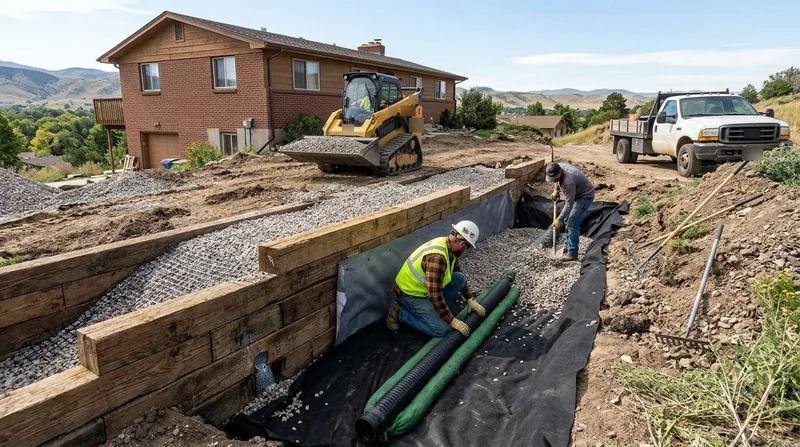




Retaining Wall Drainage in Denver is the difference between a wall that lasts 20 years and one that fails in five. Denver sits on swelling bentonite clay, and water is the enemy. Spring snowmelt, summer cloudbursts, and the freeze-thaw cycles that come with our high-altitude winters force water behind walls, build hydrostatic pressure, and push them forward or collapse them entirely. A properly drained wall sheds water before it becomes a structural load. Without drainage, even a well-built wall on solid footings will lean, crack, and fail. We install French drains, gravel backfill, weep holes, and waterproofing membranes that keep water moving away from the wall face and foundation. The result is a wall that stands true and doesn't cost you a second home repair five years from now.
Why Drainage Fails Walls in Denver: Clay, Snow, and Hydrostatic Pressure
Denver's clay-rich soil absorbs water and expands. During spring thaw and after heavy rain, water saturates the soil behind your wall. Freeze-thaw cycles crack the clay, opening pathways for more water to penetrate. That water builds pressure behind the wall, pushing it outward. The weight of a wet, expanded soil column is enormous. Add frost heave (ice lenses that form in clay and push upward), and you have a double load. Most failing walls in Denver don't fail because they were built wrong. They fail because water was never managed.
- Hydrostatic pressure from saturated clay pushes the wall face forward and destabilizes the footing.
- Frost heave lifts the wall base and creates voids that weaken the structure as the ground thaws.
- Water trapped behind the wall freezes in winter, expanding and forcing the wall outward with ice lens pressure.
- Inadequate backfill or missing gravel allows water to pool directly against the wall face, accelerating erosion and seepage.
Every one of these failure modes is preventable with proper drainage design and installation.
Key info: A 1970s timber wall in Lakewood or a 1980s railroad tie wall in Bear Valley that wasn't built with French drain and gravel backfill is almost certainly holding water and will fail within the next few seasons if not addressed now. We see this failure pattern across Harvey Park, Virginia Village, and the rolling lots on the west side of Denver.
The cost of retaining wall repair after a failure is 2 to 3 times the cost of installing drainage upfront. If your wall is leaning, cracked, or showing signs of water seepage, drainage retrofit or full retaining wall replacement may be your only option. Prevention is always cheaper than repair.
For more detail on permitting and when a wall requires a drainage system, consult the Denver Community Planning and Development office, which sets local setback and engineering requirements based on wall height and soil conditions.
How We Design and Install Drainage Systems That Work on Denver Clay
Drainage design starts with understanding the soil and water table at your property. We assess slope angle, soil type, groundwater flow, and proximity to structures. In Denver, we typically work with clay-heavy native soil that needs aggressive water management. Our approach combines multiple methods: we install a perforated drain line in gravel behind the wall, add a waterproof or water-resistant membrane to the wall face, ensure proper backfill with clean drainage rock, and install weep holes to let water escape. The gravel acts as a capillary break and allows water to flow freely down and out to daylight or to a perimeter drain. The membrane prevents water from penetrating the wall itself. Weep holes in the wall face let trapped water drain out instead of building pressure.
- We excavate behind the wall and remove clay-heavy native soil, replacing it with clean, compacted drainage rock that won't retain water.
- We install a perforated drain line (typically 4-inch PVC or HDPE) at the wall base, wrapped in geotextile fabric to prevent silt clogging.
- We slope the drain line to daylight or to a catch basin, ensuring water flows away by gravity and doesn't pool.
- We apply a waterproof membrane (sheet or spray-applied) to the wall face to prevent water infiltration through cracks or joints.
- We drill weep holes through the wall at 4 to 8-foot intervals and 12 to 18 inches above grade to allow internal water pressure to release.
The result is a wall that stays dry, doesn't build pressure, and resists frost heave and freeze-thaw damage.
Real example: A homeowner in Littleton had a 1970s railroad tie wall backing a walkout basement. Water was seeping into the basement every spring. We removed the native clay behind the wall, installed 80 linear feet of 4-inch perforated drain line in a gravel bed, added a waterproof membrane to the wall face, and drilled weep holes. Cost was $4,200. Seepage stopped completely, and the wall is now stable. Without drainage, the wall would have failed within 2-3 years, requiring a full replacement at $8,000 to $12,000.
Whether you're installing a new wall, repairing a leaning wall, or retrofitting drainage to an existing structure, we handle the full scope. See our retaining wall installation process for details on new construction, or call us at (983) 955-0165 for a free assessment of your existing wall.
Drainage Methods and Materials: What Works Best on Denver Soil
| Approach | Description | Best for |
|---|---|---|
| French Drain with Perforated Line | A 4-inch perforated PVC or HDPE pipe laid in a gravel trench behind the wall, wrapped in geotextile, sloped to daylight or a catch basin. Water enters the pipe through perforations and flows away by gravity. | Standard choice for most walls in Denver. Works on sloped and level lots. Handles high water tables and clay soil. |
| Gravel Backfill with Capillary Break | Clean, compacted drainage rock (typically 1.5 to 3-inch minus) behind the wall, topped with geotextile to separate it from native soil. Allows water to flow freely and prevents capillary rise of clay moisture. | Every wall in Denver should have this. Replaces clay-heavy native soil and reduces water retention and frost heave risk. |
| Waterproof or Water-Resistant Membrane | Sheet membrane (HDPE, EPDM) or spray-applied coating (liquid-applied polyurethane or asphalt emulsion) applied to the wall face to block water infiltration through cracks, joints, or porous material. | Walls built with porous material (stone, timber, older block). Prevents water from entering the wall structure and causing freeze-thaw damage. |
| Weep Holes and Relief Ports | Drilled or cast openings through the wall face at regular intervals and low points, allowing trapped water and air pressure to escape. Typically 1 to 2 inches in diameter, spaced 4 to 8 feet apart, 12 to 18 inches above grade. | All walls benefit from weep holes. Critical on walls that have already failed or are showing pressure signs (bulge, lean, cracking). |
| Catch Basin and Surface Swale | A stone or concrete basin at the base of the wall or at the outlet of a French drain, with a swale or pipe directing water away from the foundation. Prevents water from pooling at the wall base or backing up into a basement. | Sloped lots where gravity drainage to daylight isn't possible. Level lots where water must be directed to a storm drain or away from structures. |
We combine these methods based on your site conditions, soil type, and wall material. A timber or railroad tie wall in the foothills near Golden will need more aggressive drainage than a new segmental block wall in a newer subdivision, but both need a complete system.
Retaining Wall Drainage Cost in Denver: What to Expect
The cost of a drainage system depends on wall length, height, soil conditions, and access. A simple French drain retrofit on a 30-foot wall might run $2,500 to $3,500. A complete new drainage system on a 60-foot wall with waterproof membrane, gravel backfill, and catch basin could be $6,000 to $10,000. Factors that move the cost include soil type (clay requires more aggressive drainage), presence of existing structures or utilities, grade slope, and whether the wall is new or retrofit. A wall in a tight backyard in Capitol Hill costs more to access and work in than a wall on an open lot in Littleton. Labor, materials, and site conditions all matter.
We recommend getting 2 to 3 estimates. Each contractor may propose different drainage methods or scopes. Make sure each estimate includes a site visit, soil assessment, and a clear list of what's included: drain line type, gravel depth and type, membrane brand and coverage, weep hole count, and labor. The cheapest estimate often leaves out critical steps. The most expensive may be over-specifying. A middle estimate that includes all necessary components is usually the best value.
For detailed pricing on specific wall types and drainage scenarios, see our pricing page. For a free estimate on your wall, call us at (983) 955-0165 or use our contact form. We respond within 24 hours and provide a no-obligation quote after a site visit.
Retaining Wall Drainage Near Me: What Denver Homeowners Should Know When Hiring a Contractor
Hiring the right contractor is as important as choosing the right drainage method. A contractor who understands Denver soil, freeze-thaw cycles, and local building code is worth the call. Look for a company that's licensed and insured, has references from recent work in your neighborhood, and can explain their drainage design in plain language. Ask whether they pull permits (they should, for most walls). Ask what warranty they offer on the drainage system. Ask whether they've worked on similar walls in your area. A contractor who has done 10 timber wall drainage retrofits in Bear Valley knows Denver clay better than one who just started.
When you get estimates, verify that each contractor is licensed by the Colorado Department of Regulatory Agencies and carries liability and workers compensation insurance. Ask for proof of coverage. Check references, especially from homeowners whose walls have been in place for 3 to 5 years. Call the Better Business Bureau or check online reviews, but also talk to neighbors and local landscapers who may have hired the contractor for other work. Ask about HOA requirements if your property is in a controlled community. Some HOAs restrict wall materials or height, and a good contractor will flag those issues upfront.
Permits vary by city. Denver requires a permit for walls above 4 feet or walls that support a surcharge (driveway, deck, structure). Some of our service areas, like Littleton, Lakewood, and Arvada, have similar thresholds but may require engineered drawings for tall or tiered walls. Always verify with your local building department before you start work. A contractor who knows your city's rules saves you time and fines.
Ready to protect your wall? Contact us for a free drainage assessment. We'll visit your site, evaluate the soil and water flow, and propose a system that keeps your wall dry and stable for decades.
Retaining Wall Drainage in Denver: Pricing Guide
| Service | Price | Details |
|---|---|---|
| French Drain Retrofit (30-40 linear feet) | Starting at $2,500 | Perforated drain line, gravel backfill, geotextile, sloped to daylight or catch basin, no membrane or weep holes |
| Complete Drainage System (40-60 linear feet) | Starting at $5,000 | French drain, waterproof membrane, gravel backfill, weep holes, catch basin, labor and materials included |
| Large Wall or Complex Retrofit (60+ linear feet) | On estimate | Multi-tiered walls, high water table, tight access, or existing structures require site assessment and custom design |
| Waterproof Membrane Only (retrofit to existing wall) | Starting at $1,200 | Sheet or spray-applied coating on wall face to prevent water infiltration, labor and materials included |
| Travel and Site Visit | Included | No separate charge for work in Denver, Aurora, Littleton, Lakewood, Arvada, and surrounding areas |
| Free Estimate | No cost | Site visit, soil and drainage assessment, written quote, response within 24 hours at (983) 955-0165 |
Indicative pricing, the exact cost depends on square footage, finish, and site access. Free personalized estimate within 24h at (983) 955-0165.


