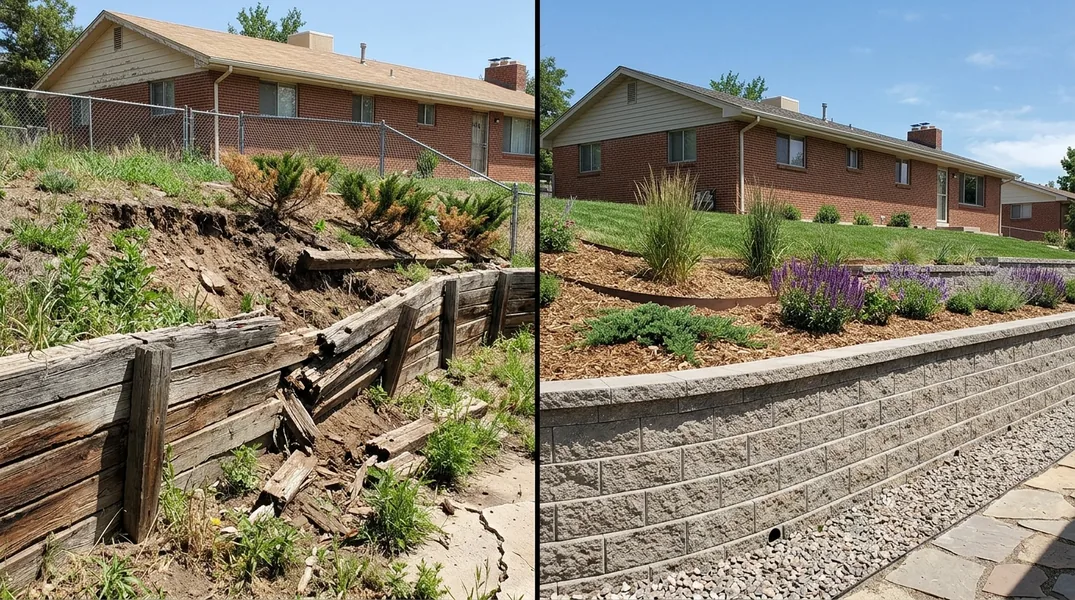
Why Denver Retaining Walls Fail: Frost and Clay Pressure
If you own a home in Denver, you've likely noticed how the soil behaves differently across seasons. Our region's combination of clay-heavy soil and freeze-thaw cycles creates unique challenges for retaining walls. During winter, moisture in the soil expands when it freezes, exerting enormous lateral pressure against your wall. Come spring, the thawing process repeats, and over time, this cyclical stress causes walls to lean, crack, or bow outward.
Clay soil compounds this problem significantly. Unlike sandy or granular soils that drain water more readily, clay holds moisture like a sponge. This trapped water becomes ice during cold snaps, and the resulting pressure can push even well-built walls out of plumb. Homeowners in Denver often call us in spring, noticing their previously straight walls now lean noticeably or display long horizontal cracks. Understanding why this happens is the first step toward deciding whether your wall needs repair or complete replacement.
Signs Your Retaining Wall Needs Attention Now
A leaning retaining wall is one of the most obvious warning signs, but it's far from the only indicator that something has gone wrong. Cracks that run horizontally across the face of the wall, particularly near the center or lower sections, suggest that pressure is building behind the wall faster than it can be safely contained. Vertical cracks, while sometimes less critical, can still allow water infiltration that worsens over time. If you notice soil or mulch spilling out from behind the wall, or if the wall is bowing outward at the top, these are urgent signals that structural failure may be imminent.
Another telltale sign is water seeping or pooling at the base of the wall after rain or snowmelt. This indicates that drainage behind the wall is failing, which accelerates frost heave and pressure buildup. Gaps appearing between the wall and the soil it's supposed to retain are also concerning. Even if your wall hasn't started to lean dramatically, any of these signs warrant a professional assessment. The longer you wait, the more expensive the eventual repair or replacement becomes, so don't ignore these red flags.
Assessing Whether Repair Is Viable
Retaining Wall Repair can be a cost-effective solution if the structural integrity of the wall is still sound and the damage is localized. Small to moderate horizontal cracks can often be sealed and stabilized with epoxy injection or polymer sealants, especially if the wall has not shifted more than a half-inch or so. Vertical cracks are frequently less critical from a structural standpoint and may be repaired without major intervention. If your wall is leaning slightly but the foundation is still level and intact, a qualified contractor might recommend anchoring systems, soil stabilization, or improved drainage to halt further movement.
The key question is whether the underlying cause of failure can be addressed without rebuilding. If poor drainage is the culprit, installing or improving a drainage system behind the wall might restore functionality for years to come. If frost heave is the primary issue, adding insulation or moisture barriers can reduce the severity of freeze-thaw cycles. However, repair is only a viable option if the wall's base is not compromised and if the lean or shift is minor. Once a wall has moved significantly or if cracks are severe and widespread, repair becomes a temporary band-aid rather than a lasting solution.
When Retaining Wall Replacement Is the Better Choice
Retaining Wall Replacement becomes the prudent option when structural damage is extensive or when the wall's foundation has shifted. If your wall is leaning more than one inch over its height, or if large sections are cracked or bowing, repair is unlikely to provide a permanent fix. Similarly, if the wall has settled unevenly or if the base has moved, the underlying problem won't be solved by patching cracks. Replacement also makes sense if your wall is very old and has reached the end of its lifespan, or if multiple repair attempts have failed to stop the deterioration.
Choosing replacement over repeated repairs actually saves money in the long run. A new wall built with modern materials, proper drainage, and frost-resistant design will serve your property for decades. Concrete Retaining Walls are particularly popular in Denver because they withstand our climate's demands better than wood or stone alternatives. Modern construction techniques account for soil type, drainage, and freeze-thaw cycles specific to our region. When you invest in replacement, you're investing in peace of mind and avoiding the frustration of watching a repaired wall fail again within a few years.
Understanding Retaining Wall Replacement Cost in Denver
The pricing for retaining wall replacement in Denver depends on several factors: the wall's length, height, material choice, soil conditions, and the complexity of drainage or foundation work required. A simple replacement of a four-foot wall spanning 30 feet might range from moderate investment to several thousand dollars, depending on whether you choose concrete, composite, or other materials. Walls that require extensive excavation, soil stabilization, or complex drainage systems will cost more. The good news is that most homeowners find replacement costs are offset by avoiding future repair bills and the peace of mind that comes with a properly engineered structure.
Rather than guessing at costs, the best approach is to request a free estimate from Denver Retaining Wall. Our team will assess your wall's condition, evaluate soil and drainage factors, and provide transparent pricing based on your specific situation. We can also discuss phased approaches if budget is a concern, or explore material options that balance durability with cost. Call us at (983) 955-0165 to schedule an inspection and get a detailed quote tailored to your property.
Making Your Decision: Repair Versus Replacement
The decision between repair and replacement ultimately hinges on three factors: the extent of damage, the underlying cause, and the wall's remaining useful life. If damage is minor and localized, and if the cause (poor drainage or frost heave) can be addressed through repair measures, then fixing the wall makes sense. If damage is severe, the foundation has shifted, or multiple repairs have failed, replacement is the smarter investment. A professional inspection is invaluable in making this determination, as it provides an objective assessment of your wall's structural condition and remaining lifespan.
Don't let a failing retaining wall become an emergency. The sooner you address the problem, the more options you'll have and the lower your ultimate cost. Whether your wall needs Retaining Wall Repair or full replacement, Denver Retaining Wall has the expertise to guide you toward the right solution. Contact us today at (983) 955-0165 or visit our website to schedule your free estimate. Our team serves Denver and the surrounding area, and we're ready to help you restore stability and safety to your property.
Looking for a professional retaining wall contractor in Denver? Denver Retaining Wall responds fast for all your retaining wall needs.
Get a Free QuoteOur services: Retaining Wall Installation · Retaining Wall Repair · Retaining Wall Replacement